The Green Hosting Revolution: Cooling the Digital Sun in 2026
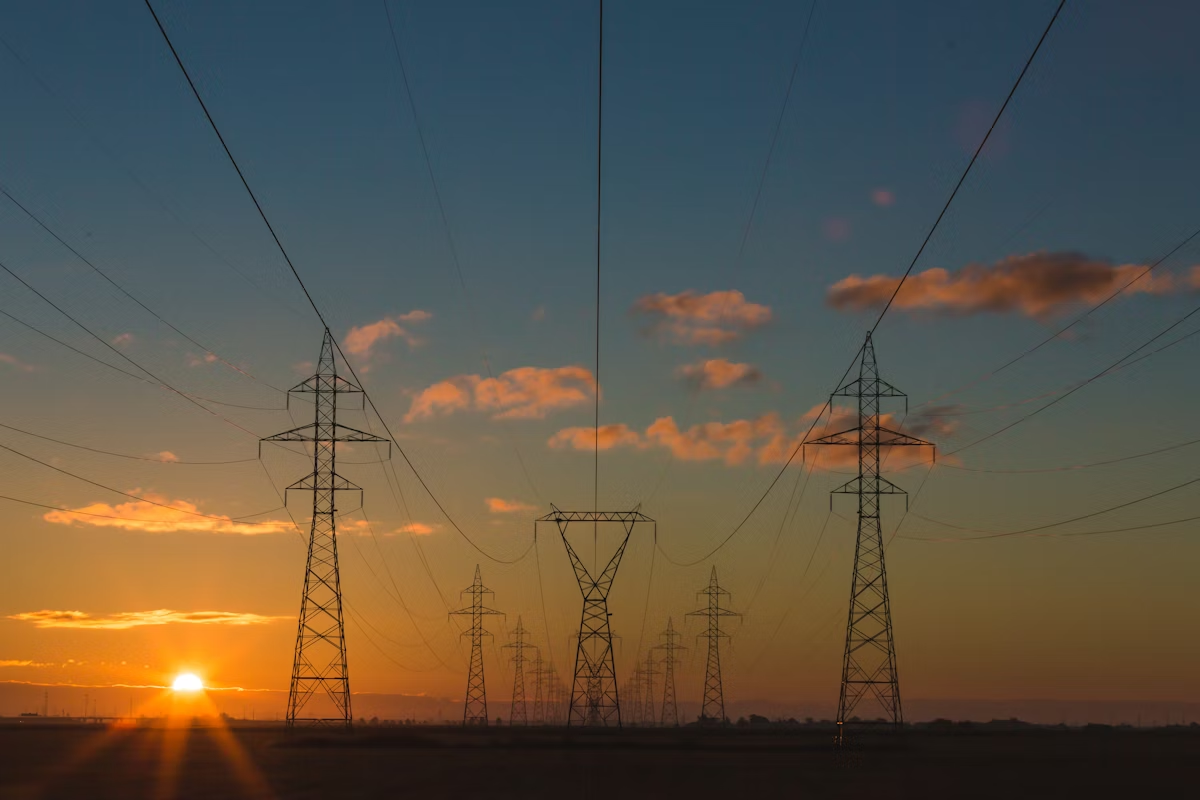
The computation explosion of the 2020s has come with a hidden cost: electricity. As Large Language Models require massive GPU clusters, data centers are consuming an ever-larger slice of the global energy pie. At Future Layer Lab, we’re investigating how the next generation of cloud infrastructure is moving toward "Carbon-Negativity."
From PUE to CUE: Measuring Carbon Usage Effectiveness
For years, data centers used PUE (Power Usage Effectiveness) as their primary metric. In 2026, we’ve shifted to CUE (Carbon Usage Effectiveness). It’s no longer enough to be efficient; you must be clean. Leading providers are now building "Carbon-Aware Data Centers" that can automatically migrate heavy non-urgent compute workloads (like model training) to regions where renewable energy (wind or solar) is currently peaking.
Liquid Cooling and the Death of the Fan
Air cooling is simply too inefficient for modern AI hardware. The "Future Layer" of physical hosting is liquid. Immersive cooling—where servers are submerged in non-conductive fluid—is becoming the industry standard. This allows for 10x higher rack density while reducing cooling energy consumption by 90%. We’ve visited several "Liquid Centers" this year, and the efficiency gains are staggering.
The Edge Sustainability Paradox
Distributing compute to the Edge (as discussed in Blog 3) actually helps sustainability. By processing data locally, we reduce the energy required to transmit massive amounts of raw data across global fiber networks. Small, energy-efficient Edge nodes powered by localized micro-grids are the future of a resilient and green internet.
A Call to Action for Developers
Code efficiency is environmental efficiency. A poorly optimized SQL query run a million times a day has a measurable carbon footprint. At Future Layer Lab, we advocate for "Green Coding"—the practice of writing energy-efficient algorithms to reduce the load on our global infrastructure. Every byte saved is a step toward a cooler planet.